GDP
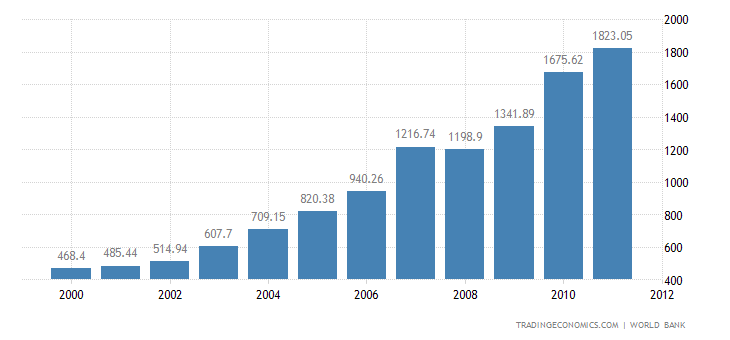
India's GDP was $1.73 Trillion as of 2010, and since then has expanded by 5.3% in the first quarter of 2012. Over the past 12 years from 2000 until 2012, India GDP Growth Rate has averaged 7.37% reaching an all time high of 11.8% in December of 2003 and a record low of 1.6% in December of 2002.
India currently have the 11th largest economy in the world .
The graph below shows how over the past 12 years, India's GDP has been rising exponentially, demonstrating the nations fast growth, and the general trend on the graph looks to indicate that it's economy is no means nears slowing down
Population
In May 2011, India's population had totalled to 1.21BN which had been recorded from the most recent census to have been carried out, making up 17% of the world's population. This has set India on course to overtake China as the world's most populous nation by 2030, but its growth rate is falling. Figures from the recent census have shown that India's growth of the 10 years has been 181 million people which is roughly equivalent to the entire population of Brazil. However this massive population increase is slower than at any time since 1947. The 2011 census charts a population increase of 17.6%, compared with one of 21.5% over the previous decade.
The data collected from 2011 census has indicated that there is population imbalance, showing that there is a strong preference in India for boys. This is because sons are still seen by many as wage-earners for the future and female abortion remain common in India, due to the assistance of sex-selective abortion based on ultrasound scans, although it is illegal. The gender imbalance has widened every decade since independence in 1947 with the increase being apperent in the 2011 census, where there were 914 girls for every 1,000 boys under the age of six, compared with 927 for every 1,000 boys in the 2001 census.
Imports and Exports
This chart shows how India's imports have changed over the past 12 years, showing a general increasing trend:

India's GDP was $1.73 Trillion as of 2010, and since then has expanded by 5.3% in the first quarter of 2012. Over the past 12 years from 2000 until 2012, India GDP Growth Rate has averaged 7.37% reaching an all time high of 11.8% in December of 2003 and a record low of 1.6% in December of 2002.
India currently have the 11th largest economy in the world .
The graph below shows how over the past 12 years, India's GDP has been rising exponentially, demonstrating the nations fast growth, and the general trend on the graph looks to indicate that it's economy is no means nears slowing down
Population
In May 2011, India's population had totalled to 1.21BN which had been recorded from the most recent census to have been carried out, making up 17% of the world's population. This has set India on course to overtake China as the world's most populous nation by 2030, but its growth rate is falling. Figures from the recent census have shown that India's growth of the 10 years has been 181 million people which is roughly equivalent to the entire population of Brazil. However this massive population increase is slower than at any time since 1947. The 2011 census charts a population increase of 17.6%, compared with one of 21.5% over the previous decade.
The data collected from 2011 census has indicated that there is population imbalance, showing that there is a strong preference in India for boys. This is because sons are still seen by many as wage-earners for the future and female abortion remain common in India, due to the assistance of sex-selective abortion based on ultrasound scans, although it is illegal. The gender imbalance has widened every decade since independence in 1947 with the increase being apperent in the 2011 census, where there were 914 girls for every 1,000 boys under the age of six, compared with 927 for every 1,000 boys in the 2001 census.
Imports and Exports
India imports were worth 41,947 Million USD in May of 2012.
Historically, from 1994 until 2012, India Imports averaged 11875.4 Million USD reaching an all time high of 42,590 Million USD in March of 2012 and a record low of 1,924 Million USD in May of 1994.
India is poor in oil resources and is currently heavily dependent on coal and foreign oil imports for its energy needs. Other imported products are: machinery, gems, fertilizers and chemicals. It's main import partners are wth the European Union, Saudi Arabia and United States.
This chart shows how India's imports have changed over the past 12 years, showing a general increasing trend:
India's exports
India's exports are currently worth 25,681 Million USD as of May 2012. Historically, from 1994 until 2012, India Exports have averaged 82,66.3 Million USD reaching an all time high of 30,418.0 Million USD in March 2011 and a record low of 1,805.0 Million USD in May of 1994. Exports amount to 22% of India’s GDP. Gems and jewelry constitute the single largest export item, accounting for 16 percent of exports. India is also the leading exporter of textile goods, engineering goods, chemicals, leather manufactures and services. India’s main export partners are with the European Union, United States, United Arab Emirates and China.
India's exports are currently worth 25,681 Million USD as of May 2012. Historically, from 1994 until 2012, India Exports have averaged 82,66.3 Million USD reaching an all time high of 30,418.0 Million USD in March 2011 and a record low of 1,805.0 Million USD in May of 1994. Exports amount to 22% of India’s GDP. Gems and jewelry constitute the single largest export item, accounting for 16 percent of exports. India is also the leading exporter of textile goods, engineering goods, chemicals, leather manufactures and services. India’s main export partners are with the European Union, United States, United Arab Emirates and China.
50 facts about India's economy
- India aims to become the world's fastest growing country by 2014
- India’s foreign exchange reserves stand at US$200B
- India has over taken the US as the second-most favored destination for foreign direct investment (FDI) in the world after China
- From reaching a phenomenal growth of 500%, the Indian insurance industry is expected to reach US$ 60 billion in the next four years.
- India adds about five million telephone subscribers every month. The total number of subscribers reached 764.76 million on the 3rd July 2012.
- India has one of the largest road networks in the world, aggregating 3.34 million kilometers. It comprises 66,590 km of National Highways, 1,28,000 km of State Highways, 4,70,000 km of Major District Roads and about 26,50,000 km of other District and Rural Roads.
- Indian ports reached an all time high during 2005-06 where they handled cargo of around 570 million
- In 2005-06, the passenger traffic rose by 25-30 per cent and is expected to grow by 25 per cent year-on-year over the next five years. While international and domestic air traffic grew by 35 per cent, cargo witnessed a 12 per cent growth.
- India is the Sixth largest crude consumer in the world.
- India is the Ninth largest crude importer in the world.
- India has the sixth largest refining capacity - 2.56 million barrels per day representing 2.99% of world capacity.
- Estimated to be a US$ 350 billion industry, the Indian retail sector is growing at a growth rate of 47%.
- The travel and tourism sector in India is generated a total demand of US$ 55,544.5 million of economic activity in 2006, accounting for nearly 5.3 per cent of GDP and 5.4 per cent of total employment.
- International Iron and Steel Institute (IISI) has ranked India as the seventh largest steel producer in the world with an overall production of about 65.93 million tons in the financial year 2010-11.
- India exports US$ 6 billion worth of garments.
- India is the largest consumer of gold jewellery in the world and accounts for about 20% of world consumption.
- India is the largest diamond cutting and polishing centre in the world.
- India is the second largest producer of rice and wheat in the world; one of the largest producers of sugar, sugarcane, peanuts, jute, tea and an assortment of spices.
- Healthcare delivery is one of the largest service-sector industries in India. The country will spend US$ 45.76 billion on healthcare in the next five years.
- The largest employer in the world is Indian Railway System, employing over a million people
- In the next three years, up to 25% of the world's new workers will be Indian
- 42% of the world's poor live in India
- India's GDP per capita will quadruple from 2007 to 2020, according to Goldman Sachs
- Property prices in Mumbai and Delhi have more than doubled in the past 18 months
- India's tech capital, Bangalore, has increased its office supply by six times since 2006, and now has more Grade-A offices than Singapore
- Half the world’s outsourced IT services come from India, amounting to a $47 billion dollar industry
- Walmart alone outsources $1 billion in IT contracts to India
- India is the world's second largest importer of arms and has spent $50 billion on defense purchases in the last decade
- India grows 12 million tons of mangoes in a year, the weight equivalent to 80,000 blue whales
- India's Cherrapnuji is the wettest places on earth, receiving 425 inches of rain every year
- A bigger movie market than America and Canada combined, India sold 3.2 billion tickets last year
- The average Indian is nearly 20 years younger than the average Japanese (26 vs 45)
- In recent decades, 500,000 female births have gone missing each year due to (illegal) sex selection and abortion
- India has 568 million more registered voters than the US and a better turnout rate
- India used to account for 33% of the world's GDP; then fell to 3%; now may rise to 25%
- Goldman Sachs, which sees India passing the U.S. economy in 2050, trailing only to China.
- The Indian economy is the world's tenth largest in GDP and the fourth largest in purchasing power parity.
- India could emerge as the world's third largest economy by 2030, benefiting from strong domestic demand and favourable demographics
- India is likely to become the world's fastest growing economy in 2012.
- The service sector makes up 54 per cent of the GDP, the agricultural sector 28 per cent, and the industrial sector 18 per cent.
- India has the world's second largest labour force with 467 million workers.
- India's working-age population will increase by 240 million over the next two decades
- Mumbai has the world's 6th most expensive office location.
- India now has a record number of 55 billionaires, their combined wealth of is $246.5 billion
- India stands third after the United States and China in the number of billionaires.
- By 2030, India's middle class population will grow to more than 580 million
Type of Economy
India has a mixed economy where both public and private sectors are present. This is the type of economy that is most common as most economic structures to some degree are mixed, but the balance between public and private sectors vary. The idea of a mixed economy was accepted in India in 1948, during the first industrial policy. In India production of arms & ammunition, ships, oil and railways are in the public sector, while transport, banking, education etc, make up the private sector of the economy.
Government Rules and Legislation
The government in power in India is officially known as the Union Government or Central Government. It was established by the Constitution of India and is the governing authority of the union of 28 states and seven union territories, collectively called the Republic of India. It is seated in New Delhi, the capital of India.
Joint Venture
A solar energy company SunEdison, which is part of the US based MEMC group has joined up with Indian energy company Azure Power to develop a 15MW solar power plant in Gujarat. This would help to benefit India as it would provide the country with cheaper fuel, helping to boost the economy, as it would increase investment in the energy market in India.
Another joint venture is in India's car industry where the Indian car makers Tata Motors is in a 50/50 joint venture with Fiat where Tata gained access to Fiat's diesel energy technology. Tata sells Fiat cars in India and is looking to extend its relationship with Fiat and Iveco to other segments. Tata has also formed several JV's with many small companies in various countries around the world. This has helped to increase the ever growing car industry in India, which aims to provide cheap cars to the Indian population. This has overall helped to boost the economy in India as it helps to boost consumer confidence and spending which promotes growth in the economy.
Economic Factors
The inflation rate in India was 7.55% in May 2012. Historically, from 1969 until 2012 the average inflation rate in India was 8% reaching a peak of 34.7% in September 1974 and a record low of -11% in May 1976.
The interest rate in India was last reported at 8% in 2012. Historically over the past 12 years, India's interest rate has averaged 6.47% reaching a peak of 14.5% in August 2000 and a record low of 4.2500 Percent in April of 2009. In India, interest rate decisions are taken by the Reserve Bank of India's Central Board of Directors.
The unemployment rate in India was 9.8% in 2011. Historically from 193 until 2010 the unemployment rate averaged 8.11% with India's l time high at it's current level of 9.8%. the record low unemployment rate in India was 5.99% in December 1994.

No comments:
Post a Comment